It’s no secret that our consumerist world has produced products across a wide range of quality and pricing tiers. It’s therefore easy to get confused about whether something is “worth the price” or not. We all know that generic store-brand flour comes from the same mill as the more expensive Gold Medal flour. Store brand cheddar tastes the same as Kraft cheddar. Surely the same is true for art supplies? Is there really a difference between artist-quality materials and student or craft quality? Actually, yes. There is a huge difference!
By the way, categories are meant to be broken, so what I’m sharing here isn’t a hard-and-fast rule. There are many, many exceptions, and the distinctions between these quality areas are changing all the time as more and more consumers enter the artistic and creative world. As the market expands, so does the marketing! But understanding this basic concept will help you see through some of the marketing hype and find products that perform the way you expect.
Artist Quality
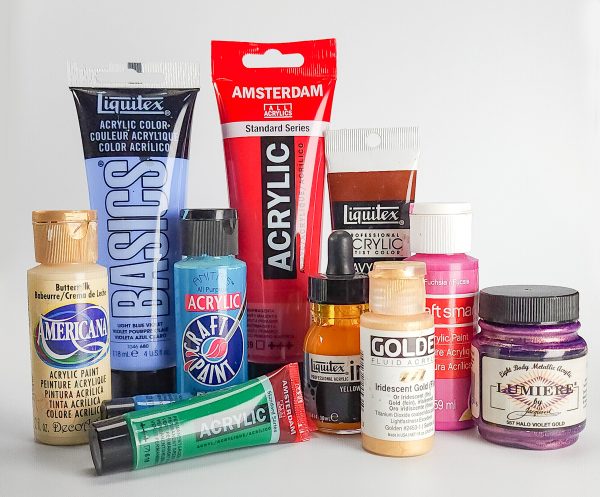
Found in art stores or the fine art department at a craft store, artist-quality materials have the highest pigment concentration and use high-quality binders that don’t degrade over time. They use a single pigment, and batches are consistent over time. When it comes to paints, they have little to no filler, and the paint’s character can depend on the pigment used. They are named by the pigment (eg. Ultramarine Blue, Viridian, Phthalo Green). Lightfastness and opacity ratings are often shown on the label. These can be very expensive because they’re made with well-performing, quality pigments, not fillers. Brand names here will be well-known and established. Examples are:
- Winsor & Newton Artists’ Oil Colour
- Golden Heavy Body Acrylics
- Liquitex Professional Acrylics
- Gamblin Artists Oil Colors
- Daniel Smith Watercolors
- M. Graham & Co. (oils and watercolors)
- Holbein Artists’ Watercolor
- Sennelier (oils, acrylics, watercolors)
Student Quality
Not everyone can afford artist-quality paints, so that’s why art supply companies developed lines of student-quality paint. These have uniform quality but use pigments in lower concentrations and may contain fillers to lower cost. They tend to perform uniformly across the entire range. They often use multiple (cheaper) pigments to recreate the look of a single-pigment artist’s color. They usually offer adequate performance, coverage, and handling similar to artist-quality materials, but at a price students can afford. The binders are adequate but not archival, so they’ll fade faster and may not mix as predictably. Names are usually generic (eg. Crimson, Sky Blue, Leaf Green, Royal Purple). Sets offer a full range of colors for fairly accurate mixing. They are usually found in the fine art area of craft stores near the good paints. This tier is usually made by flagship companies and sold as a lower-cost option. Here are some examples:
- Winsor & Newton Winton Oil Colour
- Liquitex Basics Acrylics
- Grumbacher Academy (oils, acrylics, watercolors)
- Cotman Watercolors (by Winsor & Newton)
- Amsterdam Acrylics (by Royal Talens)
- Daler-Rowney System3 Acrylics

Craft Quality
Wildly varying quality (can be utter crap), created with inexpensive pigments and dyes. Pigment loads are low, colors can be muddy, and lightfastness isn’t a consideration. These will fade noticeably within months if exposed to light. Generally, craft quality uses descriptive or invented names, such as Dazzling Grape, Cool Sage, or Mystery. Even within a brand, the suppliers change often, and quality varies. Colors are nearly always muted or have low pigment load. Colors can fade or shift, texture can be grainy or watery, and coverage can be poor. They’re fine for projects you don’t plan to keep or for kids’ use, but frustrating if you’re trying to develop actual skills because the materials don’t behave reliably. You’ll find these in the crafting department of the craft store, not the fine art department. Here are some examples:
- Apple Barrel (acrylics at Walmart)
- FolkArt (acrylics at craft stores)
- Ceramcoat (acrylics at craft stores)
- Crayola watercolors
- Prang watercolors
- Craft Smart (Michaels house brand)
- Artist’s Loft (Michaels house brand, some are student quality though)
- Arteza (see Repackagers, below)
- MonteMarte
Repackagers
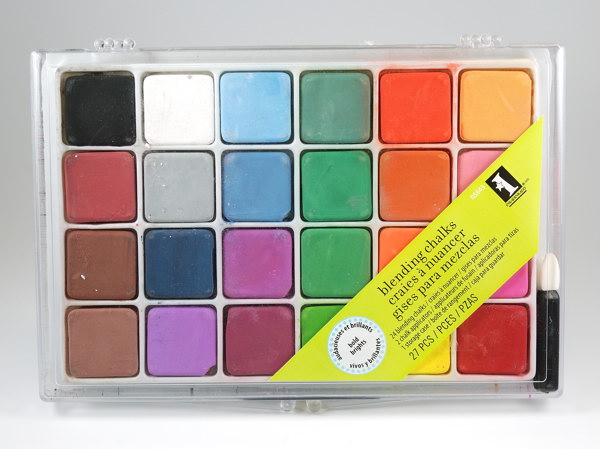
Years ago, a manufacturer made their own products and was responsible for the quality. In the past 20 years or so (and increasingly since Amazon came on the scene), brands have been created that don’t manufacture anything. They make deals with Chinese factories to package cheap, craft-quality materials into artificial brands. I call these repackagers.
Repackagers, also known to some as “drop-shippers,” frequently sell on Amazon and similar marketplaces. Make no mistake. These companies are not art supply manufacturers. They’re just having the Chinese companies put their label on the same low-quality paint the next drop-shipper is ordering. When it comes to art materials, they nearly always use craft-quality materials packaged in sets to make them look like artist- or student-quality, intending to fool naive consumers into thinking they are true artist’s materials.
Some of these “brands” go so far as to create all the possible materials and supplies that might be allied with the lifestyle the customer imagines for that identity. In other words, they will sell paints, brushes, canvas, painter’s aprons, organizers, and even carrying cases, all under the same brand. Their marketing and graphics are great. Their quality control is not. Don’t be fooled. Let price be your guide. If it’s cheap, there’s a reason. Examples of this are Arteza, CastleArt, ShuttleArt, Artbreezing, and any other brand that seems to be made from alphabet soup, like Himi, Caliart, UnuaST, TMOL, Esrich, MEEDEN, DPDian. And these brands change all the time!
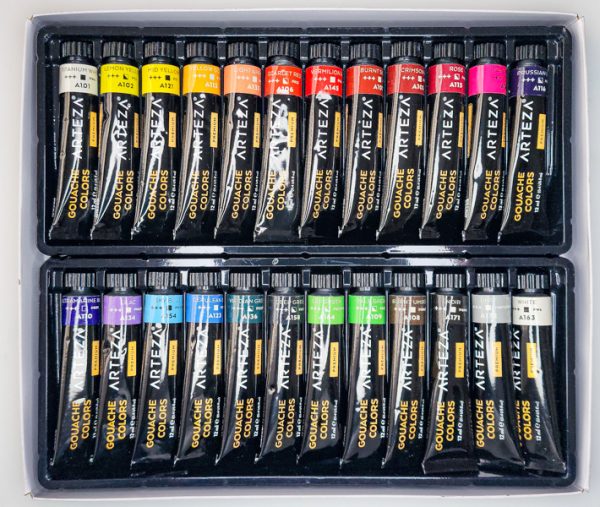
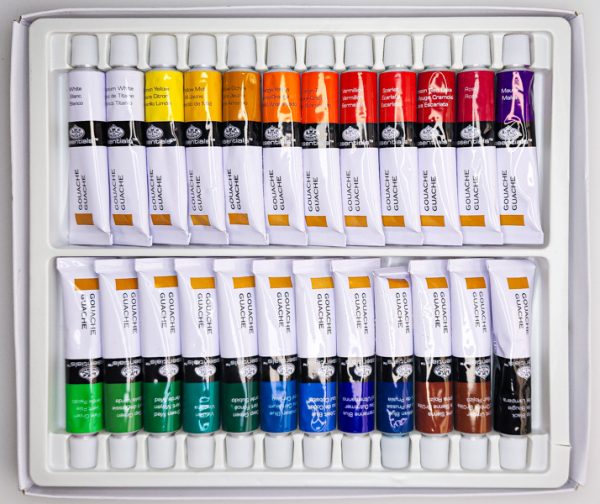
Look at the two boxes of gouache paint above. They were two separate “companies”. But, funny enough, the boxes and tubes are the same (the caps differ), and the stuff inside the tubes is identical. Are they fine art materials from a premium manufacturer? Or are they from two companies buying from the same factory in China? You tell me. 😉
What About Polymer Clay?
Polymer clay is firmly in the realm of student quality or craft quality. There is no artist’s quality brand of polymer clay. Kato Polyclay, and Fimo Professional were formulated to be “for professionals”, but their characteristics are more in line with traditional student quality materials. Sculpey III, Bake Shop, and Souffle have more in common with craft lines. And that’s exactly how they’re marketed.
I’ve often heard polymer pros lament the lack of true artist-quality polymer clays. And as an artist myself, I feel your pain! But you can’t have both low prices and artist-quality, and there doesn’t seem to be enough of a customer base willing to pay the prices that artist-quality polymer clay would require. We have to learn to maximize the use of the materials we have access to. That being said, it’s important to understand that not all brands are intended to have the same functionality. We can’t look at Sculpey III and be upset that it doesn’t perform like an art material. It has never been intended to do so! Choose the right clay for the right thing!
Oh, and by the way. You know how there are tons of “brands” of polymer clay on Amazon that nobody’s ever heard of? Let me see, right now there is CyAJM, CiaraQ, Tomorotec, and Aestd-ST on the first two pages of Amazon’s search results for “polymer clay”. (No wonder newbies are confused.) These are repackagers and likely all from the same few factories in China. I wonder what brands will be there for you if you search today?
Okay, But Does It Really Matter?
Okay, fair question. Does it really matter which type of art supply you use? Don’t they all work? Well, it depends. (Yes, you knew I was going to say that.) If you’re experimenting, learning, trying things, and growing, try everything. You’ll learn with time what can happen when you use cheap craft-quality paint on a light clay and then bake it. You’ll also learn that sometimes it really doesn’t matter. I actually use craft-quality materials quite a bit. There are times when the cheap stuff is fine. And there are times when you really want a reliable product. And only experience is going to help you know the difference.
In my humble opinion, there are two ways to go wrong here. The first is when you spend way too much money on every color of every line and every type of artist’s quality materials. It’s just not necessary. The other way to go wrong is to buy the cheap crap while assuming it’s nice quality. You’ll just be disappointed.
Using Paints and Pigments on Polymer Clay
If you’re going to use paint on polymer clay, make sure to read this article here. And if you’re going to use pigments on polymer clay, then you need to know the difference between pigments and mica. They are not the same. And finally, if you’re not yet using pastels on polymer clay, go here and read up on that. There’s a whole world out there waiting for you! Pastels are magic.