As you know, polymer clay is a sort of stiff putty that can be made intocanes and blocks. These clay pieces have designs that run through them, revealed when you cut a slice, much like you would make “slice-and-bake” cookies. If you try to cut through the clay with a regular polymer clay blade, it can be difficult to get uniform slices. Wouldn’t it be nice if there were some sort of tool for this, some sort of polymer clay slicer? Well, there is. And not just one. Here are the polymer clay slicers that are available today.
PRO Slicer
Gail Garbe and her husband Manfred have created a precision polymer clay slicer called the PRO Slicer. Manfred is an engineer and machinist by trade, so he worked hard to source and design components that he assembles into an incredibly precise and functional slicer. Here’s Gail showing how the PRO Slicer works. This is the top-of-the-line slicer and arguably the best on the market. Highly recommended for high-end pros and those who are discerning about high-quality tools.
NOTE: This is not currently available, as of February 2026. Here’s info from Gail: “The PRO Slicer is Canadian built in small batches. The main component which allows for the smooth control of both the cutting mechanism and the table movement is purchased overseas. Unfortunately we have had to put our business on hold for an indefinite period.”
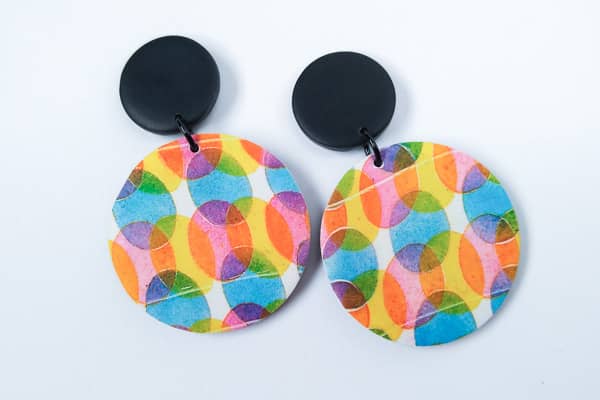
Click a Slice
Kathy Dummer (pronounced doo-mer) designed the Click a Slice, a nifty 3-D-printed slicer. Here’s where you can learn more about the Click a Slice polymer clay slicer. The name comes from the fact that you can advance the mechanism by turning a dial that clicks. More clicks will give you a thicker slice. Here’s a happy customer, Lili Vélez, demonstrating her Click a Slice so that you can see how it works. Thanks, Lili!
This is an entry-level slicer that works well. Heartily recommended for anyone who is tired of the wonky slices they slice their polymer clay by hand.
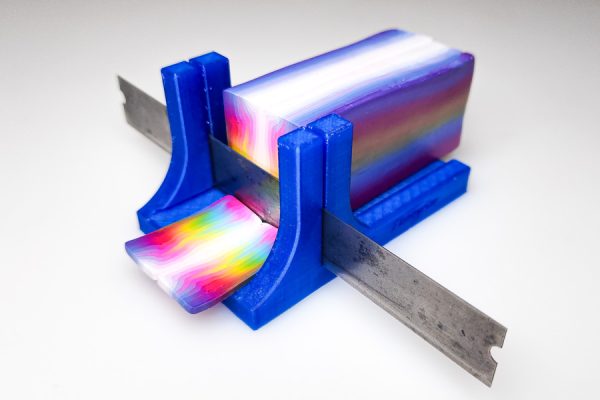
Hobbyrian Slicer
This simple 3D printed polymer clay slicer from Hobbyrian has no moving parts and is essentially a slicing guide for you to use with your own blade. There is no mechanism to advance the clay and it relies on you carefully placing the clay block for each slice. It’s very inexpensive and isn’t meant to be a precision instrument. But if you are pretty good at slicing and just need a little guidance, this simple tool might be just what you need. I do think it works best with small canes, though. I found that a big cane like this moved too much.
Other Polymer Clay Slicers
Lucy Clay Tools Polymer Clay Slicers
The big elephant in the room here is the polymer clay slicers from Lucy Clay Tools. I didn’t go into more detail on them because they’re not currently in production and not currently available. I did write reviews on the old versions that you see pictured below, and you can follow the links to read them. I do know that the company is actively pursuing production at this point and a brand new slicer is projected to become available sometime in 2026.
You can read my previous articles about the Lucy Clay Slicer, as it first came out. And then the Lucy Clay Mini Slicer here. Remember, these are no longer available, but you may encounter them on destash sites.
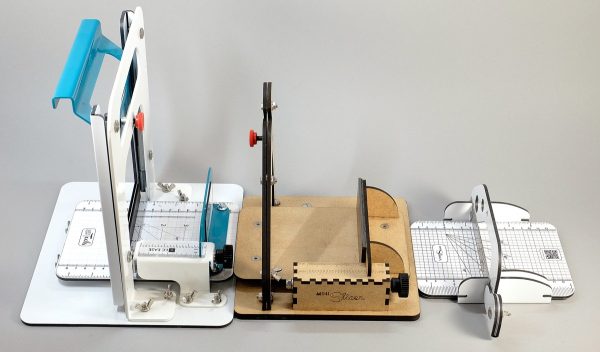
SLICERoo
Recently made by an Australian Company, the SLICERoo was available for a short time from My Clay Co. I’ve not heard if more production runs are coming. The slicers sold out in days, so I expect to see more of this brand. Stay tuned!
Slicing By Hand
I have to step in here and put up a vote for slicing by hand. I learned to clay long ago, before slicers were a thing. And I learned to slice my canes by hand. It is a skill, like anything else. It does require practice, careful observational skills, time, and patience. But please know that it IS possible!
I mainly slice polymer clay canes by hand into paper-thin slices for layered flower compositions with translucent backgrounds, as you see here.

When slicing tissue-thin like this, I hold my cane vertically in my hand and cut with the blade going toward my thumb. It works best with small canes, good vision, and an ultra-sharp tissue blade. By the way, this blade is a rigid Cernit blade I just bought from Blueberry Beads, and it’s ultra-sharp. Excellent. It goes without saying, anytime you are using an ultra-sharp blade…BE CAREFUL. These blades are sharp enough to cause severe damage when used carelessly.

The cane you see above was made by Toni Street. Toni makes incredible millefiore pens and also slices her canes by hand. For large canes where you need a whole lot of equal thickness slices, however, I do recommend using the Click a Slice or the PRO Slicer, above.