(In this “Ginger’s Musing” from Blue Bottle Insiders, I wrote it while I was taking a wheel-throwing class at a local pottery studio.)
Because it’s been Thanksgiving break, we didn’t have pottery class this week. But there’s a code for the door, so I can go in anytime I want to practice. I’ve spent a lot of time in the pottery studio, trying to figure out how to make my hands throw pots. I’m not very good. Yet. But I am seeing progress.
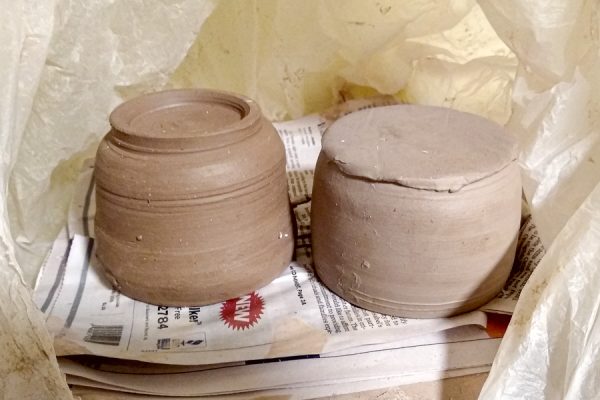
One thing I’ve really enjoyed is the lack of pressure to know what I’m making. At this stage in learning to wheel-throw pottery, the objective is to “pull a cylinder”. In other words, you just practice (over and over) the act of centering the ball of clay, making a hole in the center, and pulling the sides up into a cylinder. Once you can do that effectively, then you can start intentionally shaping the cylinder into a vase, bowl, mug, or cup. Most of the time, however, beginners have no idea what the clay will become because we have so little competence to intentionally create a specific form. When the cylinder becomes off-center or wonky, it gets turned into “something”. Lots of stumpy, fat cups at this point. 🙂
I think this type of non-specific practice is imperative. This is how we develop the medium-specific skills that are necessary when it’s time to be intentional about WHAT we want to create.
I think polymer artists set themselves up for failure by assuming they should lead with design.
Design, color, composition, and the intense process of idea generation are separate skills from the technical skills of handling your medium or craft. And they are endlessly more difficult. Artists spend their entire careers learning to refine their ideas, their voice, and their designs. But all too often I see makers trying to make great designs when they don’t yet have the skills to support what they want to make. Or worse, they’re paralyzed and have no idea what to make because they feel that everything they make should be a great design. It’s hard to get lots of practice when you’re afraid of ruining your design.
Why do we do this to ourselves? Why don’t we practice learning to handle our clay? In our pottery studio, students can’t advance to the Intermediate class until we can consistently pull a cylinder with even walls. What’s the equivalent in polymer clay? Can you consistently make a skinner plug the desired size? Have you mastered the ability form a pinch pot in your hands, with even walls? What about rolling a perfectly round bead or a snake of even diameter? Can you make and flawlessly finish a simple shape?
I think we’d all be a lot less frustrated if we looked at our polymer clay the way that we look at learning pottery. Focus on learning the basic process well, not on creating a great design. The design work comes later. Don’t try to learn everything all at once!